Q1 2026 Aluminum Price Surge: Cost Impact and Strategic Response for Foil Sealing Film Manufacturers
In Q1 2026, LME aluminum surged approximately 16%, hitting a four-year high of $3,571/tonne on April 15. China's SHFE rose 5.2% to an average of RMB 24,191/tonne — up 18% year-on-year. Three converging forces — Middle East conflict, US tariff restructuring, and China's production ceiling — pushed sealing film raw material costs up an estimated 13–15%. This article traces the price trajectory, explains the domestic-international divergence, and outlines four strategic responses.
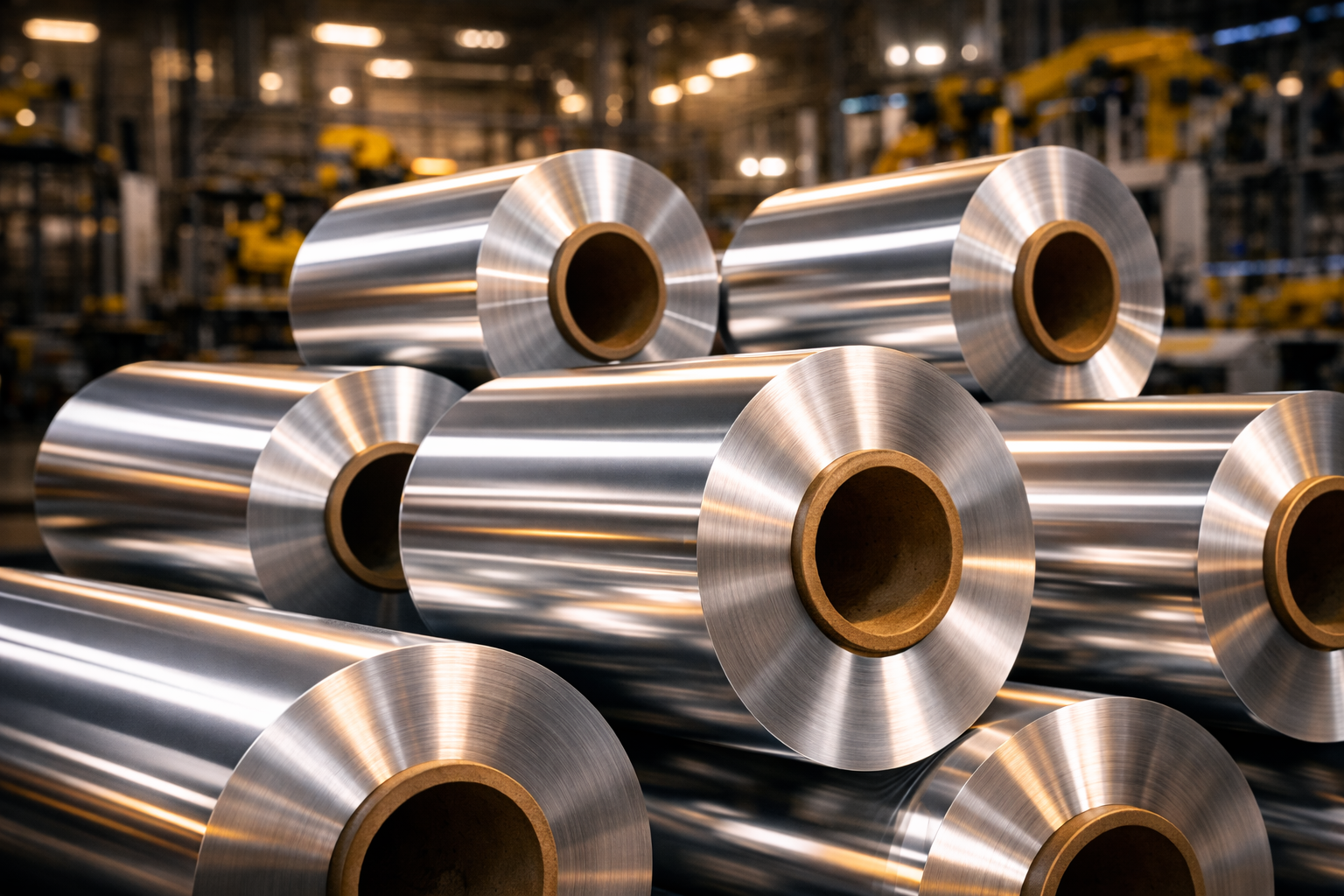
Q1 2026 Price Review: From Historic Highs to Wide-Range Volatility
The global aluminum market traced a steep upward arc in Q1 2026, followed by violent swings that have left manufacturers navigating the most uncertain raw material environment in four years.
January: Breaking historic highs. After the New Year, SHFE aluminum futures surged from approximately RMB 23,155/tonne to above 25,000/tonne within a single month — a level that had never previously been breached. By January 6, the contract had already risen roughly 13.8% from early December 2025 levels. On January 28–29, as Middle East tensions escalated sharply, SHFE aluminum hit an all-time high of RMB 26,225/tonne, a single-day gain of 4.54%. LME simultaneously broke above the psychological $3,000/tonne threshold for the first time in the cycle. [1]
February: Limit-down, then stabilization. On February 2 — the last trading day before China's Spring Festival — hawkish Federal Reserve signals triggered a broad risk-asset selloff. SHFE aluminum hit the daily limit-down, falling 9.01% to RMB 23,035/tonne. The Yangtze River spot A00 ingot price fell RMB 960 in a single day. Markets spent the remainder of February consolidating in the RMB 23,500–24,500/tonne range.
March: Geopolitics reignite, wild swings. On March 9, Qatar's Qatalum smelter reported a gas supply interruption while Bahrain's Alba declared force majeure, pushing SHFE back toward RMB 26,200/tonne. A strengthening dollar and recession fears then drove prices down over RMB 3,000 within a week to approximately RMB 23,100/tonne. The "Fire Weekend" of March 28 — when Iran struck UAE's EGA Al Taweelah facility (approximately 1.5 million tonne/year capacity) and Alba — reignited the market, and SHFE closed March at approximately RMB 24,875/tonne. [2]
April (latest): As of April 15, 2026, LME aluminum prices spiked to $3,571 per tonne, a level not seen since the 2022 energy crisis. The Q1 LME average was approximately $3,199/tonne, up 21.9% year-on-year. SHFE's Q1 average was RMB 24,191/tonne, up approximately 18% year-on-year.
Three Structural Drivers: Why This Is Not a Temporary Spike
This price surge is not driven by a single event. Three independent structural forces have converged simultaneously — making a rapid reversal to pre-2026 price levels unlikely.
① Middle East supply disruption — the most immediate shock
The combination of the Hormuz blockade and physical strikes on EGA and Alba facilities has removed nearly 3 million tonnes of annual capacity, creating a deficit that cannot be easily filled by existing idled plants. The Gulf region accounts for roughly 9% of global primary aluminum output. EGA's Al Taweelah smelter suffered pot freezing — a failure mode with a recovery timeline measured in years, not months. The Middle East conflict creates a two-way blockade: alumina raw materials cannot reach regional smelters, and finished primary aluminum cannot be exported, affecting approximately 8.2% of global aluminum output.
② US tariff restructuring — an accelerator of cost transmission
The April 2, 2026 Section 232 tariff restructuring fundamentally changed how aluminum duties are calculated for US importers, applying rates to the full customs value rather than just the metal content. The US Midwest Premium surged to a historic high of approximately $1.10/pound (around $2,425/tonne). This means US buyers face effective landed costs approaching $5,000/tonne or above — far above the global benchmark.
③ China's production ceiling — the structural price floor
China's electrolytic aluminum production capacity is hard-capped by policy at 45 million tonnes/year. As of March 2026, operating capacity stood at approximately 44.47 million tonnes with a utilization rate near 98%, leaving less than 500,000 tonnes of additional headroom. Morgan Stanley has noted that the approximately 4% global supply loss from the Middle East conflict may persist through 2026, with capacity restart timelines of 12 months — supporting medium-to-long-term upward price logic. The production ceiling has severed the traditional "high margins → capacity expansion → price decline" feedback loop that historically capped aluminum prices.
The Domestic-International Divergence: Why SHFE Rose Only One-Third as Much as LME
Despite the sharp LME surge, SHFE's gains were considerably more muted — approximately 5.2% for the quarter versus 16% for LME. Unlike upstream miners, downstream manufacturers felt the squeeze immediately: between January 6–8, window and door companies across Beijing, Guangdong, and Hubei issued price adjustment notices of RMB 10–100 per square meter, reflecting rapid cost transmission pressure.
Three factors explain why domestic prices lagged international ones:
- High inventory suppressing spot prices. Aluminum ingot inventory rose 38,000 tonnes week-on-week to 1.387 million tonnes, remaining at elevated levels. Yangtze River spot prices traded at a discount of approximately RMB 80–120/tonne to futures, with trade activity thin as holders held firm on price while buyers resisted paying highs.
- Weak downstream demand. China's real estate sector remains depressed (new housing starts fell over 20% year-on-year), and downstream consumption in home appliances and automotive has not recovered. Downstream operating rates were approximately 65%.
- Import window closed. The SHFE-LME ratio fell to approximately 7.6 — a four-year low — making aluminum imports uneconomical at a loss exceeding RMB 2,000/tonne. The domestic market could not use imports as a price relief valve.
The practical impact on sealing film manufacturers: With SHFE up 18% year-on-year and aluminum comprising 70–80% of foil production costs, raw material pressure alone has pushed sealing film input costs up an estimated 13–15%. This is a sustained, structural cost increase — not a temporary spike to wait out.
Four Strategic Responses for Sealing Film Manufacturers
① Upgrade pricing mechanisms — build in dynamic adjustment clauses
The "aluminum ingot + conversion fee" pricing model is now the baseline. But without adjustment clauses in contracts, rising raw material costs become a one-sided risk. We recommend adopting tiered adjustment triggers: if the SHFE monthly average rises more than 8% from the contract baseline, a price renegotiation is automatically triggered. This separates raw material volatility from manufacturing margin.
② Lock in long-term supply contracts now
In the near term, aluminum prices will continue in wide-range oscillation between "macro headwinds" and "supply scarcity" narratives. If Middle East tensions escalate further, prices may break upward; if Fed hawkishness intensifies, prices may test the RMB 24,000/tonne support level. In this high-uncertainty environment, quarterly or semi-annual fixed-price agreements with foil suppliers provide meaningful protection against spot price volatility. For international buyers sourcing from China, the current moment is the window to lock in pricing before any potential second-leg upward move.
③ Pursue lightweighting — reduce aluminum content per unit
Reducing sealing film thickness from 70μm to 40μm cuts aluminum consumption per unit by approximately 43% — directly offsetting a large portion of the raw material cost increase while simultaneously aligning with EU PPWR's lightweighting requirements. This is the highest-ROI technical response to raw material inflation available to sealing film manufacturers.
④ Move up the value chain — premium products carry stronger pricing power
In an environment of rising input costs across the board, product differentiation is the most effective profit protection strategy. Pharmaceutical blister lidding films, coffee capsule sealing foils, and high-barrier retort food packaging all command pricing premiums that standard commodity films cannot sustain. Manufacturers holding food-grade and medical-grade dual certifications, operating cleanroom production environments, become genuinely irreplaceable in their buyers' supply chains — and that irreplaceability translates directly into pricing power.
Outlook: The Price Floor Has Shifted Permanently
Major institutions have divergent near-term forecasts: Citi has raised its 0–3 month target to $3,600/tonne with an extreme scenario of $4,000; Goldman Sachs projects a Q2 average of $3,450 but anticipates a pullback if Middle East tensions ease. Morgan Stanley targets $3,700/tonne for full-year 2026.
The core structural judgment is clear: the aluminum price floor has shifted permanently higher compared to 2024. Even if a Middle East ceasefire drives LME prices lower, China's production ceiling, the EU's CBAM carbon tariff (whose costs were formally incorporated into European aluminum price assessments by S&P Global from April 2026), and the long-term contraction of smelting capacity outside China will collectively prevent a return to pre-2025 price levels.
For aluminum foil sealing film manufacturers, this means cost management is no longer a reactive function — it is a core competency. Companies that establish dynamic pricing mechanisms, complete lightweighting upgrades, and secure international compliance certifications now will build durable first-mover advantages through this raw material cycle that their competitors will find difficult to replicate.